
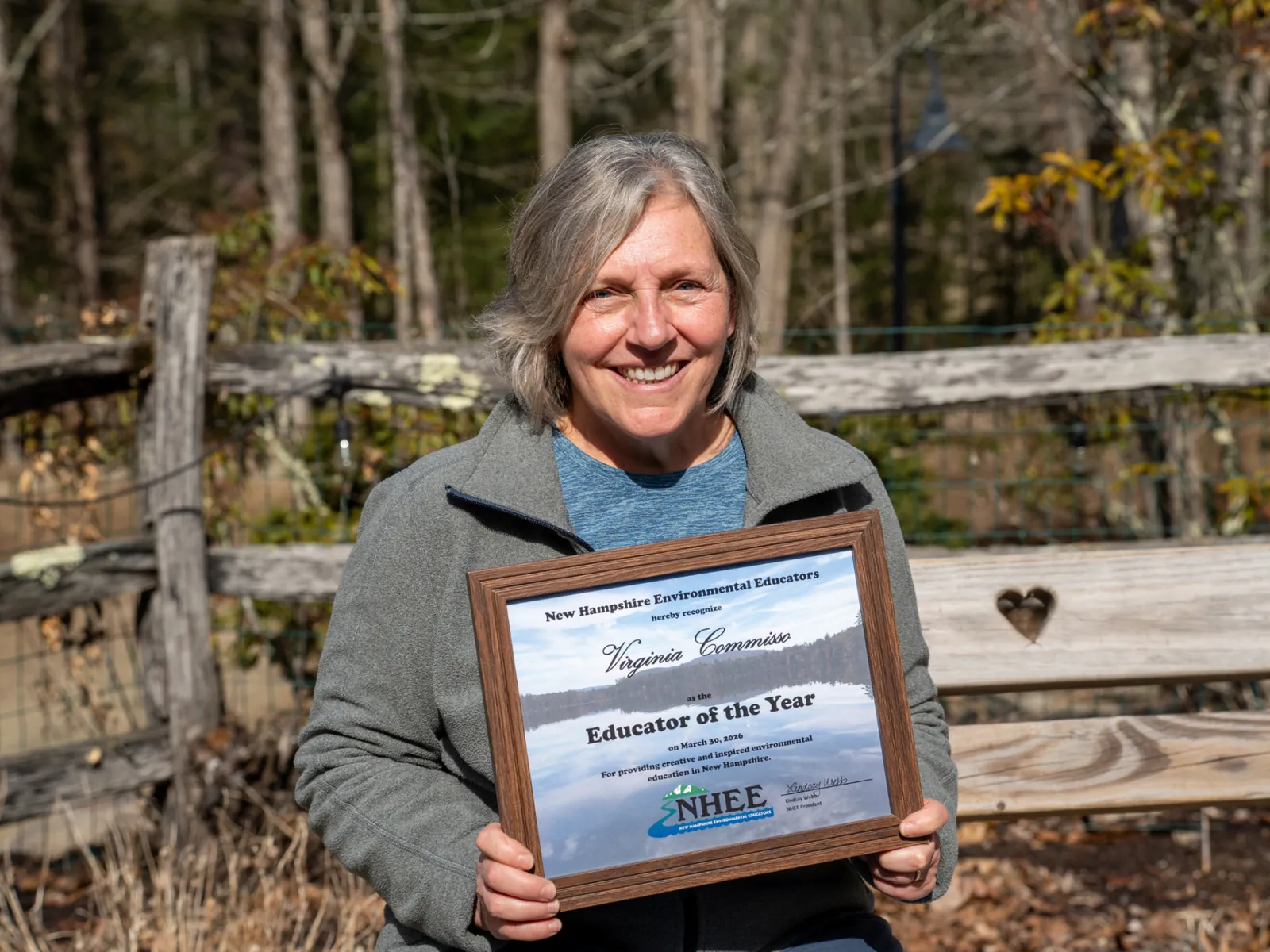
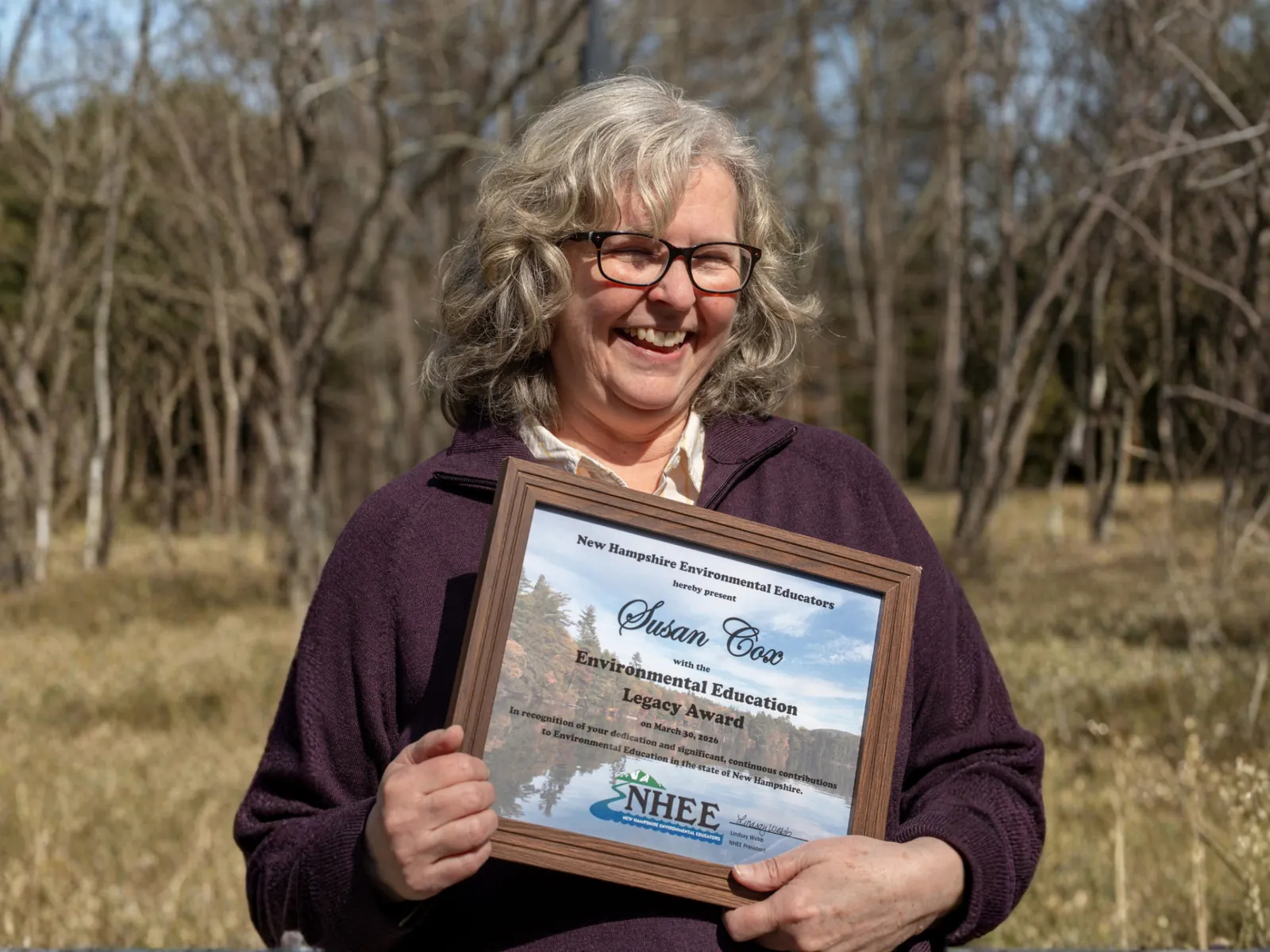


 Margaret Gillespie was recognized for her decades of inspiring environmental education at Squam Lakes Natural Science Center, where her work in curriculum development and naturalist-led programs has sparked curiosity and stewardship among learners of all ages.
 Kathleen Stowell was honored for her commitment to engaging students and community members in hands-on watershed education through her leadership at the Lake Sunapee Protective Association, advancing environmental literacy across the region.
Helen served as the Director of the Amoskeag Fishways Learning and Visitors Center for almost 20 years (since October 1999). The Fishways reaches approximately 25,000 people per year. The year round education center at the Amoskeag Fishways, where Helen is the Director, closed on March 8, 2019 and transitioned back to a seasonal visitors’ center, open only during fish migration season in April-May-June. Helen has poured her heart and soul into making the Fishways an exemplary and unique education center. She mentored many naturalists, allowing them to develop and grow their skills and EE repertoire under her tutelage. She is responsible for the creation of many effective environmental education programs for all ages. During the 24 years of partnership that kept the center open year round, Fishways programs reached 127,000 Manchester area school children through 5,350 school programs!
Whether it was through direct interpretation with visitors, teaching programs, or program development, Helen has reached and affected the lives of countless learners of all ages at the Fishways. One of the things that best exemplifies her work is her commitment to systems thinking, mindfulness and sharing strategies with other educators.
Helen’s teaching always incorporates a description of how the program content relates to the larger ecological picture. When she leads tours or teaches programs related to the Amoskeag Fishways site and fish ladder, she routinely includes a discussion focused on how the site connects to the larger Merrimack River ecosystem and watershed. Visitors inevitably leave with a better understanding of the connections between migrating fish, other river life, people, the Merrimack River and its watershed.
One of the most effective strategies to engage students in environmental studies in lasting and meaningful ways is to educate teachers and leaders in program delivery, engaging activities and self-reflection. Helen is a gifted teacher who has led numerous workshops designed to energize and empower teachers to feel confident with environmental education techniques to create cross-curriculum application.
Helen encouraged Fishways staff to incorporate mindfulness into both their teaching and program design, which created a meaningful and effective change in the way Fishways programs were delivered. Helen has developed and taught mindfulness programs where she helps participants connect to their inner selves through experiences in nature. She also developed and facilitated teacher workshops about mindfulness in the classroom, helping teachers create a more focused and calm learning environment.
-Michael Bartlett


Ellen O’Donnell has over fifteen years of experience working in environmental education. She currently teaches middle school science at Deerfield Community School and has been active in implementing curriculum that gives students the opportunity to work outdoors including work to build school gardens. She participated in the Fulbright program studying environmental education and was named Project Learning Tree Outstanding Educator of the Year in 2017.
 Kelly Lynch Dwyer has over 20 years of experience in Environmental Education most recently as the lead educator at the New Hampshire Audubon at Massabesic. She has been active in coordinating the Eco-Schools program and weaving in multiple disciplines in her teaching. She has been active in the Urban Bird Program and has been a presenter at NHEE, NHSTA, and NEEEA conferences. She served on the Board of Trustees of NH Audubon from 2008-2015.
 Peter teaches life sciences at Newfound Regional High School, where he has worked with community partners to create an engaging and meaningful learning experience for his students. Paul Hoiriis, Principal of Newfound Regional High School writes, “In his eleven years in the teaching profession, he has continued to develop and grow as an educator, never afraid of change and learning new methods…Peter has developed curriculum that is real world, hands-on, and often connects students with our local resources and environment.” For example, Peter coordinated with Hubbard Brook Experimental Forest to help students create tree health assessments in his class. While he has experience teaching a wide-range of classes in biology and physical science, he continually challenges himself by offering new classes for students to delve into, such as Zoology, which will be added to the courses available at Newfound Regional High School. He also frequently utilizes the surrounding area and the school greenhouse to teach students outside of the classroom.
In addition to his work in the classroom, Peter also serves as an advisor to the Outdoor Club in his community and offers New Hampshire Fish and Game Hunter Education classes. In these activities he encourages students to form connections with their environment and build a conservation ethic that will last throughout their lives. Recently Peter coordinated a deep sea fishing trip to help students learn about marine ecology. He also assisted with a new program, Newfound Adventures, which included visits to Mt. Washington to view the unique ecology of the alpine zone, a nearby Pine Barren, and Odiorne Point to see an example of an intertidal ecological community. Peter continues to make a positive impact on his school and community and we are pleased to celebrate his contributions to Environmental Education.

It would be a pleasure to hear Carol tell her story herself. This knack for storytelling is what makes Carol such a special educator. Her ability to captivate an audience allows them to take in the full experience, almost seeing it as if they were there.
Carol has been a part of the Tin Mountain team since 1990. At the age of 50 she went back to school and earned a graduate degree in Environmental Studies and a Master’s of Science in Teaching at Antioch University. A nominee for Carol, Corrie Blodgett, recalls many examples of her brilliant stories about the Legend of Chocorua, handmade board games combining history, problem solving, and environmental issues. Carol’s research in history astonishes many on her walks through historic places in the Mountain Washington Valley.
The vast collection of materials that Carol uses to teach about everything from geology to photosynthesis is shared amongst the staff and Tin Mountain. A great teacher and also a mentor to others, Carol embodies the sense of nature to the point where you might feel as though you “met mother nature herself” according to Corrie Blodgett.
Mary has helped numerous people reach out and connect to our natural world for over thirty years with the New Hampshire Parks, and now New Hampshire Fish and Game as a Wildlife Educator. Mary’s quiet dedication over the past several years has rewarded many.
She is the Project WILD Coordinator as well as the co-editor of the project WEB newsletter. At Fish and Game Mary coordinates and develops curriculums that are used widely in schools. She oversees the Wonders of Wildlife Program at Fish and Game, training volunteers who present over 100 programs per year. Also in her realm is the Winter Severity Index program which involves students collecting weather data that is then used by biologists in assessing the impact on white-tailed deer. Her work in these areas and others (Wildlife Stewards program, Growing Up Wild, Becoming an Outdoors-Woman workshops) has put her a step above and much deserving of this award.
What tends to stand out with Mary is her non-stop dedication that affects so many people. Her diligent work has improved her own understanding about what teachers need. She even earned a teacher’s certificate. Mary has trained and given experiences to countless people. Judith Silverberg, a colleague, stated that Mary is an “excellent naturalist” and is known for her calm approach and high “level of preparedness”.
Laura Alexander was nominated by a former student who studied under her guidance at Colby Sawyer College. He credits her for having inspired a curiosity about the natural world in all of her students, including his own appreciation for nature and sense of place. Another former student explains that the courses he took with this professor, as well as her “contagious dedication and enthusiasm for environmental education […], continue to influence [him] in [his] professional career.” At Colby Sawyer College, she has worked to expand the field study opportunities of her students, and has recently worked with her department to generate a proposal for a distance learning degree in Environmental Science. As evidenced through the Community-Based Research Projects she has led, as well as her participation in conservation groups such as the Ausbon Sargent Land Preservation Trust, she engages both personally and professionally to advance environmental science in the community. Her specific focus is often on the flora of an area, and their use as ecological indicators. She recommends that her students use a field guide along with a map when trying to orient themselves in a new place. Where we to try and orient ourselves at Colby Sawyer College today, we might want to access the ‘virtual herbarium’ first—an online guide to local flora that she designed herself—before touring a locally harvested post and beam structure that students are building, the sustainability garden, and the maple sugaring house. Her students see a direct correlation between these new initiatives on campus and her involvement with the College. We are very proud to award the NHEE Non-Formal/Higher Learning Educator of the Year to Laura Alexander, who in the words of one student, “inspires students as well as colleagues, advances environmental education, teaches with enthusiasm and innovation, and is personally committed to environmental issues and causes.”
John Slater educates Middle School and High School students through the NH Envirothon, a statewide environmental science competition. In recent years he has helped to guide the Envirothon’s “land-based problem,” and has steered it towards topics that encourage students not only to engage with the subject matter, but also with their surrounding communities. One of his colleagues observes that, “Getting the students out to explore issues in their home areas has led to enlightenment for the community leaders and municipal groups, businesses including farms, other students and educators in their schools, their families and neighbors, [and that’s] in addition to what the students discover. There has been an important exchange of information as the students learn how the topic will affect people in their daily lives, municipal rules and laws, and impact businesses. Some of the students repeat their presentations for their Planning Boards +/or Conservation Commissions, and other students.” John manages the content for this statewide competition, and also provides direct support for students, even inviting them to use his personal e-mail if they have questions about presentation parameters or other concerns. As one colleague notes, John often plays the important role of reminding judges in the competition that “these students are not doctoral candidates and should be treated in a positive and supportive manner to help build their skills in making effective presentations in challenging situations.” These are just some of the many ways that he makes sure he’s on the same page as the students, working with them to help them gain the most positive experience possible. Perhaps the most telling part of his deep commitment to teaching and the environment is the fact that all of the work he puts into the Envirothon is on a volunteer basis, all in addition to his job at SNHU. We are proud to present this year’s NHEE Middle/Secondary Educator of the Year Award to Dr. John Slater.
Judy Silverberg was presented with this award to recognize the many years she has served as an advocate for environmental education. When Judy moved to New Hampshire from Wisconsin in the 1970’s, she served as the Chief Parks Naturalist for the New Hampshire State Parks. She created and implemented an interpretive plan for the state park system. The Student Conservation Association, through its NH Parks AmeriCorps Program, is still following Judy’s model to provide interpretation to thousands of park visitors each season. Following her years in NH State Parks, Judy worked as a 4-H and youth development educator for UNH Cooperative Extension before moving to NH Fish and Game, where she stayed for 27 years. She launched many innovative conservation programs including NH Project Wild in 1985, Aquatic Resources Education in 1988, Wonders of Wildlife in 1990, and the Schoolyard Habit Program (Project Home) in 1991. Under Judy’s direction, conservation education at NH Fish and Game addressed the challenges facing science and conservation education statewide. Judy’s wisdom, energy, and vision moved NH Fish and Game and its conservation education unit into partnerships that have greatly increased their impact on conservation and environmental education in the state. Through the years, Judy encouraged collaborations that made Amoskeag Fishways Learning and Visitor Center a reality, as well as the Project Web Newsletter, the state Watchable Wildlife Program, Barry Conservation Camp, Discover Wild New Hampshire Day, and the N.H. Education and Environment Team (NHEET) which provides cutting-edge professional development opportunities for teachers. Judy has been a leader in the environmental education community and a proponent of quality science education in New Hampshire. She helped shape the N.H. Frameworks for Science, chaired the group that developed the state’s Environmental Literacy Plan, and was a founding member of the N.H. Children and Nature Coalition. At the national level, Judy is known for her work as the principal investigator for the Association of Fish and Wildlife agencies in developing the North American Conservation Strategy and her service on the 21st Century Conservation Service Corps. Although Judy is officially “retired”, she continues to work in the environmental education field with many groups in the state. She is the part-time coordinator of New Hampshire Project Learning Tree and is an adjunct professor at Southern New Hampshire University. It would be hard to count how many tens of thousands of the state’s youth have been touched by Judy herself or through her initiatives. It would also be difficult to count how many environmental educators have been mentored by Judy as they followed their own paths. She continues to be a strong advocate and practitioner of environmental education in the state. Judy truly demonstrates the commitment and qualities that represent an outstanding non-formal environmental educator.
Sarah Larson-Dennison, a 4th grade teacher at Moharimet Elementary School is definitely an outstanding environmental educator. She and her students are pioneer members of Maple Watch, a study of the health of maple trees, and have partnered with researchers from the University of New Hampshire. Sarah has been a key leader at Moharimnet by developing a maple sugaring program that involves every child at the school. She has helped develop activities and curricula for each grade level so that maple sugaring can be integrated into each age group and discipline. Sarah and her students have collected sap samples for chemical analysis at UNH. In the future, students will report out phenologic events such as first sap run or leaf out to help gather valuable research information about a tree that is considered an indicator species for climate change. In addition to teaching her own students, Sarah has shared her program with other teachers. As a Maple Watch pilot teacher, Sarah is working with teachers from eight other New Hampshire schools to develop research protocols and classroom lab activities. Last year Sarah shared her ideas and experiences at the UNH Forest Watch annual meeting. Sarah’s citizen scientist students are touching nature in a way that will give them lifelong ties to nature and a conservation ethic.
Stacey Egan and Emily Wruble were recognized jointly for their collaborative partnership with their students at two different middle schools. Since 2008, Stacey Egan and Emily Wruble have been participating with their 8th grade students in the Harris Center facilitated Otter Brook Farm Project. This project brings together two middle schools from the same school district to work with naturalists and ecologists at the farm. Students collect data, analyze the data, and draw conclusions throughout the school year. In June the two schools meet at Otter Brook Farm to participate in a service project, and then share and discuss their year-long studies. This project brings students together, through the context of field ecology, who will be attending the same school as ninth graders. Stacey and Emily, through this project, build a bridge between the two schools, linking their students as partners, collaborators, and scientists.
Susie Spikol Faber is the School Outreach Coordinator and Teacher Naturalist at the Harris Center for Conservation Education in Hancock. She has been on staff in various positions at the Harris Center since 1991. As a dedicated environmental educator she has taught a wide variety of topics to students ranging from preschoolers to senior citizens. She puts her endless energy and skills as a terrific teacher to use as the director of the Harris Center day camp, the in-school naturalist for several Monadnock Area schools, and the advisor for the Conval Envirothon team. She helped establish and run The Environmental Studies Institute, a life-long learning program for elders. She is a keen naturalist, avid gardener, beekeeper and orchardist. Susie is well known in the community as a collaborator, reaching beyond the classrooms to team up many outside of the education field to enrich the learning experience of her students. Susie is eager to build on her knowledge and regularly engages in professional development opportunities and new explorations. She is always willing to help others learn and has served as a mentor for many graduate students and emerging professionals. One such student wrote: “Her patience with young children and adults alike is admirable, and she possesses a genuine passion for connecting kids of all ages with the natural world that she herself deeply cares for. Under her leadership I myself have grown as an educator and I feel incredibly lucky to have her guidance and ongoing mentorship as I begin my own career.” Another tribute was submitted that sums up a lot of what Susie has done and stands for: “My first interaction with the Harris Center came when I was 6 years old. We dissected owl pellets, walked through wetlands and vernal pools, and on one cool night we called for owls in the woods around the Center. I think that those experiences and having the ever enthused Susie as our guide, made me want to really understand nature. I am 24 now, and have graduated with an Environmental Studies degree and currently work with the Natural Resources Conservation Service and Student Conservation Association.” The lives of countless children and adults have been enriched by the work of Susie Spikol Faber.
Mary Robidoux teaches at the Hallsville Elementary School in Manchester. When not at school she raises free range chickens and is an avid composter and gardener. Mary has brought those interests to her school where she founded a Gardening Club for the students. Through that program, students compost food waste from the cafeteria and grow their own vegetables and flowers at the school garden. Mary has taught the students how to collect seeds and cultivate them. Raising plants from seed to harvest enables the students to put into practice science process skills, math applications, writing techniques, and other integrated topics. Mary’s students have had many first hand opportunities to learn about environmental stewardship as they discover how to care for plants and their patch of ground. This project is not just something Mary jumped into because of the trendiness of school gardens. She started with a compost bin in her classroom over 10 years ago and used the end product for nourishing plants around the front walkway of the school. Her ability to create hands-on gardening experiences for urban children was enhanced by the grant funding she was awarded. Mary also engaged AmeriCorp crews and the City of Manchester Highway Department and other community partners to assist with establishing the garden. In addition to the garden, Mary uses eggs from her chickens to conduct an incubation and chick development unit with her students. She is a thrifty recycler of cast offs and “wastes”. From garden kneelers made out of newspapers and old plastic table clothes to making light tables out of donated materials Mary promotes social responsibility and wise use of natural resources. The physical grounds at Hallsville are greatly enhanced by her passion, innovation and commitment to sustainability. Mary inspires her colleagues as well as the children and the Hallsville School community through her work.
Clare Long is an amazing individual with incredible passion for education. She is the 2011 NH Environmental Educator of the Year for the Non-Formal Category. Throughout her career she has worked for many organizations including the USDA Forest Service, Appalachian Mountain Club, NH Project Learning Tree, Weeks State Park, SPNHF’s Rocks Estate, and the National Association for Interpretation. Clare has shared her love for the environment with all ages while wearing many different hats. Her enthusiasm is evident whether it be while writing an environmental education curriculum for the Physical Education program at Pinetree School in Center Conway or working with professionals in the forest service. Her current position is as the White Mountain National Forests Conservation Educator. Here, she continues her diverse work by developing programs for children and adults, by working with many different program areas including recreation, timber, and wildlife, and by creating public awareness for the Forest Service and helping to connect all of their environmental partners. This requires Clare to think outside the box and use her amazing creativity. Her work touches the lives of thousands of people. Jen Werda from the Pemi Baker Leadership Academy met Clare while enrolled in the Forest For Every Classroom workshop about 5 years ago. She remembers this crazy red head leading a bunch of teachers into the woods at night to do activities in the Hubbard Brook Experimental Forest. Her enthusiasm was contagious. Jen was so nervous and excited, especially when Clare started calling to the owls and they called back! Jen wanted to know how she could get her students that excited about our natural environment. Clare has an amazing way of getting people excited about what she is working on and guiding you as you step outside of your comfort zone to explore new forest concepts.
Lisa, known as ‘Water Woman’ at Nashua’s Bicentennial School, is the 2011 NH Environmental Educator of the Year for the Elementary Category. Lisa focuses on student understanding and inquiry as she teaches her 5th graders about water systems, cycles, and conservation. She engages parents and the community, getting entire families excited and involved in environmental endeavors. Lisa connects her students with environmental professionals including fish biologists and hatchery workers, a scientist in residence program, and watershed protection volunteers. Her students participate in engaging field trips to a fish hatchery, wastewater treatment plant, and a canoe trip down the Nashua River where they conduct aquatic insect investigations and water quality testing. With the help of the mascot Polly the Pickerel, Lisa illustrated how water flows through the neighborhood and how actions of individuals can affect their drinking water. Similar in-depth studies touch on other environmental topics. Lisa’s work is not just in teaching students, but in designing strong educational practices. Working with Project Learning Tree’s Connecting Schools to People and Places, Understanding by Design and other innovative methods, Lisa has worked with a team from her district to discuss, develop and implement best practices for science education within the district. As a result, their NECAP science proficiency scores have risen from 54% to 70% in the past three years. Lisa’s love and commitment to science and the environment resonates in her personal life and makes her teaching genuine and realistic. NHEE joins her students, parents and colleagues in recognizing her dedication to environmental education.
The recipient of the 2011 NH Environmental Educator of the Year award for the Secondary Category is Mark Pedersen of Timberlane Regional High School in Plaistow. Mark was chosen because of the combination of his personal and professional commitment to environmental stewardship. He shares his passion for the environment with his students, colleagues and community by his words and actions. These actions include launching a student investigation of Timberlane’s energy use. They went beyond a typical audit by calculating alternatives and cost saving measures which were presented to the school board. By implementing some of these recommendations the school has reduced energy costs, pollutants and received an Energy Star award. Mark has helped initiate other activities in and out of school including school wide recycling, an environmental service club, coastal cleanups, ecological research projects, and teaching about local food which resulted in student designed websites to assist farmers with marketing. Mark has retooled the Timberlane Environmental Science curriculum to combine physical science and biology in a single year-long course with a focus on sustainability. This systems approach has inspired his colleagues and helped his students’ understand their impact on the environment. The combination of innovative curriculum, engaging lessons, service learning projects and personal commitment make Mark Pederson an educator worthy of recognition. In the words of one of his students, ‘Mr. Pedersen is a great teacher and a great person too. He really deserves this award.’
The Environmental Educator of the Year award in the Non-formal category is being given to Wendy Schorr. Wendy worked in the Manchester City Schools teaching deaf students for 16 years before she began working for the Amoskeag Fishways in 1998. Since then she has personally reached nearly 35,000 children through school programs, fish tours and public events. As an educator, Wendy has written and taught curriculum relating to fish, watersheds, urban wildlife and other conservation topics. She has coordinated the Adopt a Salmon program, providing teachers with instruction and students with an understanding of the life cycle of an anadromous fish and the importance of stewardship of resources. Her indoor classes are usually filled with live animals and natural objects. When outdoors she encourages all ages to discover and explore. She will even go into a stream in February in search of macro-invertebrates. Her compassion for animals is illustrated by her enthusiasm for Lamprey Appreciation Day and her role as the wrangler of the Fishway’s resident rattlesnake. Puppets and games made by Wendy help children engage in learning in creative ways. She captivates with a quiet approach that allows students to discover their own mysteries and answers, and serves as a stellar role model for learning to love and care for the earth. When it comes to environmental stewardship, Wendy is a living example of the principles she teaches. She and her husband live in a solar powered home, built from wood off their land. They raise much of their own food in organic gardens and orchards. Wendy has served on the Deerfield Conservation Commission and various town committees related to environmental issues. Several of us have had the pleasure of serving on the NHEE board with Wendy. She also served as co-chair of the Program Committee when NH hosted the extremely successful 2008 NEEEA Conference. In each of these roles Wendy has brought an incredible attention to detail, creativity, and an appreciation of team work. To quote from her nomination form, ‘She is a quiet leader and mentor, is modest, self effacing, talented, and treasured’. We are so privileged to offer this award to Wendy Schorr.
This year’s recipient for the NH Environmental Educator of the Year for the Elementary School level is Carol Foley. Carol’s may be a familiar face because she likely holds the record for attending more environmental education conferences and workshops than anyone else in New England. Though Carol currently works as the Special Education and Math Coordinator and Coach at the Ellis School in Fremont, she has held many positions during her career. She has worked directly with children as well as with other educators. Recently she led teachers in grades 1-6 through a 15-month professional development process to vertically align her district’s science curriculum and match it with the NH Science Frameworks. This enabled science to be taught regularly in each grade level, something not previously done. At other schools Carol has breathed new life into science curriculum with many interactive activities that stretch beyond the typical lessons. Her classrooms were often home to snakes, frogs, turtles, rodents and birds, all of which became part of her teaching team as her students saw their biology lessons come alive. Carol’s passion for learning and sharing is illustrated by the fact that she is a facilitator for PLT (1998), WILD (1988), and WET (1999). She has helped bring these EE tools to hundreds of other classroom teachers around NH. She has conducted many other workshops for NH Audubon, NHSTA, Squam Lakes Natural Science Center and others. Carol also reaches beyond the classroom through work in non-formal settings. By bridging these two sectors she has enriched both areas. She has served on the NHEE board providing insight into school needs and issues. At various jobs, Carol has shared her skills with organizations including NH Audubon, Amoskeag Fishways, Squam Lakes Natural Science Center, the SEE Science Center Museum, White Mountain National Forest, McAuliffe Planetarium, Montshire Museum, Boston Museum of Science, and the Swift Water Girl Scout Council. Carol is receiving this award not because of one specific project, event or talent, but because of her continued dedication to engaging students in environmental studies, her breadth of experience with methods and audiences, her unending interest in gaining and sharing new skills, and her commitment to connecting people with the natural world. It is with great pleasure that I present this award to Carol Foley.
This year’s secondary award winner is Bruce Gorrill from Brewster Academy in Wolfboro, NH. He was nominated by Peter Hess, the Dean of Studies at Brewster. Bruce has been the Science Department Chair at Brewster for the past 18 years. During that time he has shown his commitment to Environmental Education in many ways. Bruce started and currently heads the Environmental Club which initiated a recycling program, conducts Earth Day activities, and campus wide clean up days. He designed a Freshwater Ecology course in which his students conduct weekly field studies, design research projects, and create podcasts to report out their findings. Bruce is a firm believer that the focus should be on the process of science instead of straight facts. His curriculum uses 21st century skills and web 2.0 technologies to ensure his students are maximizing the benefits of technology. He is a role model to his peers in his willingness to grow and change with the current trends in education. He was recently involved in a 3 year NSF study on technology in science education. Bruce inspires his students to make real changes in their lives. Students from his class designed and presented to the head of schools a schoolwide project were his students challenged their classmates to reduce their water consumption. Water use data was analyzed by dorm from water bills obtained from the business office. Bruce also shows his personal commitment to the environment by working with local restaurant owners to provide him with fuel for his veggie powered car. It is our pleasure to present this year’s secondary award to Bruce Gorrill.
The recipient of the 2009 NH Environmental Educator of the Year Award for the Elementary School category is someone who may not fit the typical model of an environmental educator. In fact when she was told that she’d been chosen to receive the award, she asked if there was some mistake! However there is no mistaking the commitment and enthusiasm of Mindy Beltramo, school librarian at the Peter Woodbury School in Bedford. As a librarian, Mindy is a resource person. She has provided resources in the form of insight, coordination, information, community connections and inspiration to students, fellow educators and parents in Bedford. For the past 8 years she has initiated and directed the annual Science Day. The themes of these days have included Agriculture & Eating Locally and Alternative Energy. She sponsors a winter writing contest which bridges disciplines and links the environment with literature. Her library not only houses books but also is filled with interesting objects from the natural world including a very large python skin which she uses to spark interest in reading and writing. But one important book sparked Mindy’s interest. After reading Last Child in the Woods, Richard Louv’s seminal work on children and nature, she launched a remarkable effort to convert their school yard into a community park and education facility. She has spearheaded grant applications, community sponsorship, student fund raisers (including one student who asked that in lieu of a Christmas presents her family donate to the schoolyard project) and collaborative efforts with landscape design students from NHTI. The Peter Woodbury School community school yard is even featured on the national No Child Left Inside website. Due to her efforts students will experience education by interacting with the natural world, families will share in the learning and the community has come together in support of this project. Mindy has also joined the NH Children in Nature Coalition to extend her desire to connect children with nature throughout the state. Many thanks to Mindy for doing all that she does for her students and her community as an environmental educator.
When Antrim Elementary School Principal Debbie Lesure heard a 3rd grader say, ‘Wouldn’t it be cool if there were a woods in Antrim?’, she brought her staff together to see how they could address this question, because of course in a rural town like Antrim, there is a lot of woods! The Reverence of Place Committee was formed, made up of Debbie, 1st grade teacher Michele Johnson, 4th grade teacher Fabiola Woods, Judith Bernardi the School Nurse and Ann Marie Given, a Paraprofessional. Together these women put together a comprehensive curriculum to truly build a reverence of place for the students in their school. Using the McCabe Forest (189 acre preserve owned by the Society for the Protection of New Hampshire Forests, within walking distance of the school) students explored vernal pools, searched for insects, examined trees, studied habitats, and had many hands-on experiences. They became engaged in their learning by creating Quests, using clues to guide visitors to special spots. The year culminated with a special family event where children got to teach their parents about the woods they had come to love. By linking the rubrics of education into the natural world, both environments were enhanced. School and learning became richer and the McCabe Forest now has a huge fan club. Thanks to the Reverence of Place Initiative, it’s not only cool to have a woods in Antrim, but it’s even cooler that children and their families know about it and feel a sense of connection to it.

 In 1977, Julia Steed Mawson joined UNH Cooperative Extension and served as the Director of the Visitor Center at Odiorne Point State Park in Rye, NH. For more than a decade she shared her creativity, enthusiasm and knowledge with the Sea Grant Program, Marine Docents, college interns, and school children. She co-authored marine education books, was a founding member of the Gulf of Maine Marine Educators and spent a lot of time in tide pools. In 1991 she moved inland to direct the Pine Island 4-H Environmental Education Center in Manchester and focus on the needs of urban youth and families. She continues to bring an environmental focus to 4-H programs in Hillsborough County and an inclusive focus to the environmental education community in New Hampshire. Her most recent accomplishment includes coordinating the NH Common Ground Garden Program where she has built partnerships between the Massabesic Audubon center, the Manchester Housing Authority, the Latin American Center of Manchester, Girls, Inc of Manchester and many others. Her students (many of whom are at risk youth) plan and plant gardens and grow food for themselves and local food pantries. By doing so, they connect with the earth and each other, enhance their own nutritional health and work toward improving the health of their community and the planet. Julia’s work broadens what it means to be an environmental educator and serves as a reminder of the importance and unique gifts that each living being brings to the table.

